
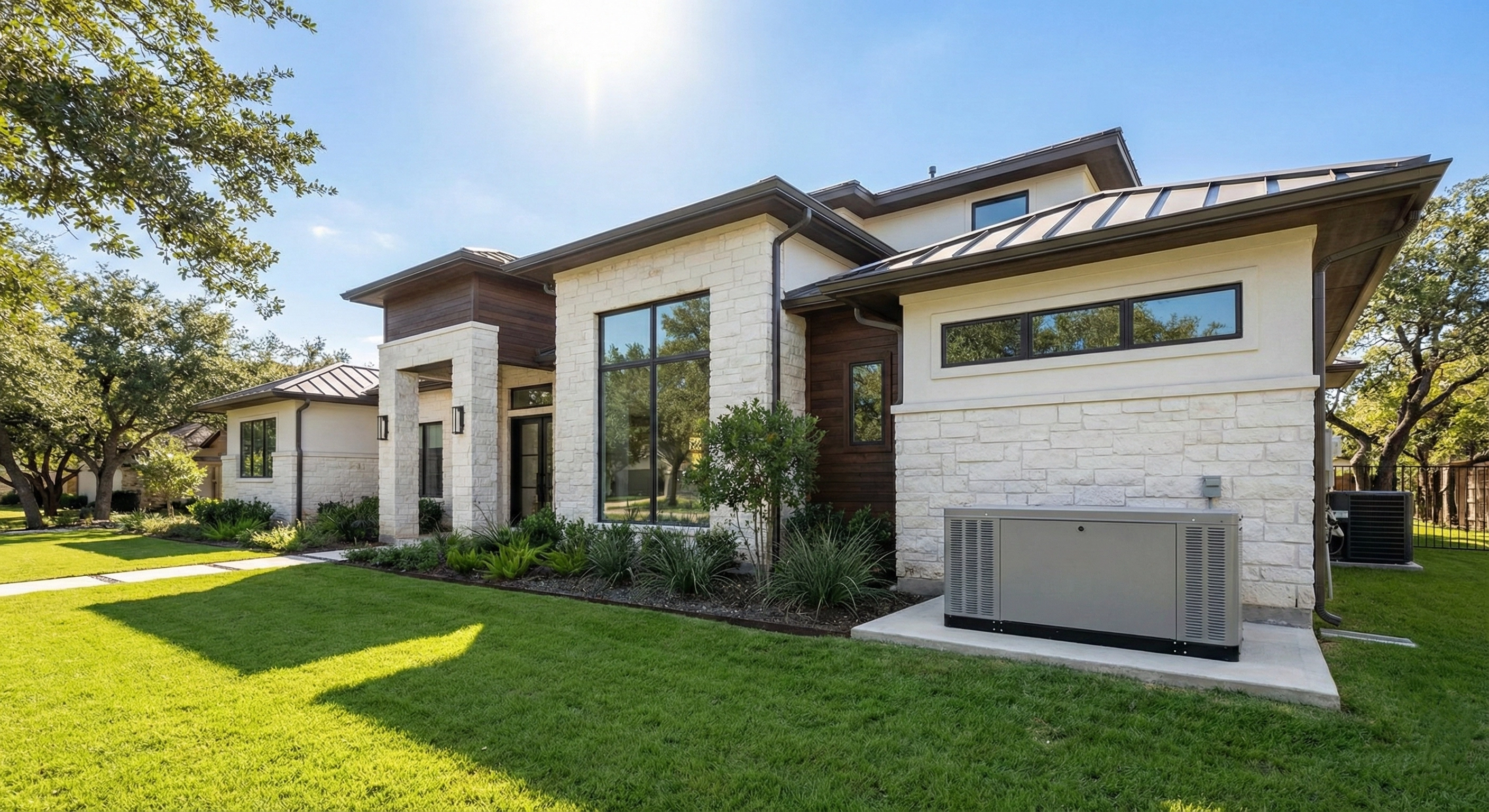
Residential Generator Services
Complete installation, maintenance, and emergency service for your home
What is a Standby Generator?
A standby generator is a permanently installed backup power system that automatically restores electricity to your home within 10-30 seconds of a power outage. Unlike portable generators that require manual setup and refueling, standby generators connect to your home's natural gas or propane supply for unlimited runtime and use an automatic transfer switch to seamlessly power your entire home or essential circuits during grid failures. These systems are designed for whole-home protection, providing 8-48 kW of power capacity depending on your home's electrical needs.
Standby generators operate automatically and require no intervention during power outages. Making them ideal for protecting your home when you're away, asleep, or unable to manually operate backup power equipment. Professional installation ensures code compliance, proper sizing, and reliable operation for 20-30 years of service life.
Standby vs Portable Generators: Complete Comparison
Choosing between a standby and portable generator? Here's how they compare across key factors:
| Feature | Standby Generator | Portable Generator |
|---|---|---|
| Installation | Permanently installed outside home | Manual setup required each use |
| Activation | Automatic (10-30 seconds) | Manual start, manual transfer |
| Fuel Source | Natural gas or propane line | Gasoline (manual refueling) |
| Runtime | Unlimited with natural gas | Limited by fuel tank (4-12 hours) |
| Power Capacity | 8-48 kW (whole home) | 3-10 kW (essential circuits only) |
| Typical Cost | $6,000-$15,000 installed | $500-$3,000 (unit only) |
| Maintenance | Annual professional service | User maintenance, seasonal prep |
| Noise Level | Quiet (60-70 dB at 25 feet) | Loud (70-90 dB) |
| Weather Protection | All-weather housing included | Must be outdoors in dry area |
| Operation During Outage | Zero intervention required | Must be outside, monitored, refueled |
| Carbon Monoxide Risk | Minimal (professionally vented) | Higher (must maintain safe distance) |
| Best For | Whole-home protection, extended outages, convenience, peace of mind | Temporary power, budget solution, occasional use, camping |
Professional Installation
Turnkey Generator Installation
From design to commissioning, we handle everything. Our experienced team manages permitting, electrical work, gas line installation, and final testing to ensure your generator is ready when you need it most.
We approach every installation as if it were for our own home. Done safely, built to code, and made to last. No shortcuts, no surprises, just professional work you can count on.
Properly installed and maintained generators deliver exceptional reliability when you need them most. According to industry data from leading manufacturers, standby generators with regular annual maintenance have a 98% successful start rate during power outages. Systems with semi-annual maintenance contracts experience 70% fewer emergency service calls and have an average service life exceeding 25 years. Making professional installation and ongoing maintenance a smart long-term investment.
Get a Free QuoteWhat's Included in Your Installation
Everything you need for worry-free backup power
Site Assessment
Detailed evaluation of your home's power needs and optimal generator placement.
Permits & Approvals
We handle all permits, inspections, and municipal requirements.
Electrical Work
Professional electrical connections and transfer switch installation by licensed electricians.
Gas Line Installation
Safe natural gas or propane line installation to fuel your generator.
Concrete Pad
Stable, level concrete foundation for your generator system.
Testing & Training
Complete system testing and owner training on operation and maintenance.
How to Choose the Right Generator Size for Your Home
Selecting the correct generator capacity ensures reliable backup power without overspending on unnecessary capacity.
What is an Automatic Transfer Switch?
An automatic transfer switch (ATS) is the control system that continuously monitors your utility power and automatically activates your standby generator when an outage is detected. Within seconds of sensing power loss, the ATS signals your generator to start, waits for it to reach proper operating voltage and frequency, then seamlessly transfers your home's electrical load from utility power to generator power. When utility service is restored, the ATS reverses the process. Transferring your home back to grid power and shutting down the generator after a brief cool-down period.
The ATS is the "brain" of your backup power system, making standby generators truly automatic and requiring zero manual intervention during outages. Professional installation ensures the transfer switch is properly sized for your electrical panel, programmed with appropriate delay settings, and compliant with local electrical codes. Quality automatic transfer switches are designed for 20+ years of reliable service and thousands of transfer cycles.
Professional Maintenance Service
Your generator sits idle most of the time, but when a storm hits, it needs to start immediately and run for hours. Maybe days. Regular maintenance ensures your system is ready when you need it most.
The impact of regular maintenance cannot be overstated. According to a study by the Electrical Generating Systems Association (EGSA), 80% of generator failures during emergency operation are preventable through routine maintenance. Generators that miss scheduled service are 5 times more likely to fail during the first hour of a power outage. Precisely when you need them most. Our maintenance contracts ensure your investment protects your family when it matters.
Our comprehensive maintenance service includes oil changes, filter replacements, battery checks, load testing, and complete system diagnostics. We catch small issues before they become big problems.
Schedule MaintenanceExpert Maintenance
Maintenance Service Plans
Choose the plan that fits your needs
Annual
Once per year
Semi-Annual
Twice per year
Commercial
Custom schedule
How to Prepare Your Generator for Hurricane Season
Ensure your backup power system is ready before storms threaten the Gulf Coast (June 1 - November 30).
What is Generator Load Testing?
Generator load testing is the process of operating your backup generator under its full rated electrical load to verify it can perform as designed during an actual power outage. Unlike the weekly automatic exercise cycle (which runs the generator at minimal load for 15-20 minutes), load testing simulates real-world emergency conditions by applying the generator's full electrical capacity using either your home's actual electrical systems or specialized load bank equipment. This critical test confirms the generator can start reliably, reach proper operating temperature, maintain correct voltage and frequency, and sustain power delivery for extended periods.
Load testing is essential because generators can develop "wet stacking" and other performance issues when only exercised at low loads. Professional load testing should be performed annually at minimum, with semi-annual testing recommended for critical applications. Buffalo Power Solutions includes comprehensive load testing in all maintenance contracts, using calibrated equipment to document your generator's performance and identify potential issues before they cause failures during emergencies.
Our Installation Process
Consultation
We assess your home's power needs and recommend the right generator size and placement.
Design & Permits
We create installation plans and secure all necessary permits from local authorities.
Installation
Our expert team installs the generator, transfer switch, and all connections in 1-3 days.
Testing & Training
We test the system thoroughly and train you on operation before we leave.
Ready to Protect Your Home?
Get a free consultation and quote today